SIMD.ai → SIMD.info Migration and Roadmap
Phase 1: Testing (Completed)
Over the past months, we have made our custom SIMD.ai LLM available for testing. Its original goals included:
- High-accuracy translation of SIMD intrinsics between x86 SSE4.2, Arm NEON/ASIMD, and POWER VSX (128-bit), with 256-bit and 512-bit support in development.
- Deep domain knowledge of SIMD intrinsics, mappings between architectures, and detailed SIMD-specific queries.
- A distilled dataset capable of matching the SIMD-focused performance of very large LLMs.
Key Limitations Observed
During testing, we also identified several issues:
- Users asked about technologies outside the model’s scope (e.g., AVX-512, SVE2, SME2).
- Requests for auto-vectorization (e.g., “vectorize this C code for SVE2”), which is compiler work, not the goal of the LLM.
- Generic chatbot-style questions, unrelated to SIMD.
- Non-English queries, which are outside our intended scope.
Additional Challenges
- SIMD development requires SIMD translation only part of the time; a flat subscription model is sub-optimal.
- Developers with proprietary code cannot safely use an online chatbot for sensitive code.
- For local use, a small specialized LLM is more practical than a 100B-scale model.
Conclusion: A chatbot is not the correct interface for a highly specialized code-oriented LLM.
Phase 2: SIMD.ai Roadmap
A redesign will require rework, refactoring, and new fine-tuning efforts. During this process, the original SIMD.ai service must be temporarily disabled. Meanwhile, our VSCode extension Code.SIMD continues to be heavily used internally, so we are separating the three components:
- SIMD.info
- SIMD.ai
- Code.SIMD (VSCode extension)
The goal is to support both local and cloud-based AI-assisted SIMD development.
Step 1: Migration to SIMD.info + Code.SIMD
User management is being migrated to SIMD.info, and Code.SIMD will connect directly to it.
Because this is a different service, we are requesting your permission before migrating your account.
Step 2: SIMD.info Becomes Subscription-Based (With a Free Plan)
To support ongoing development, SIMD.info now requires free registration for some parts of the site (Latency/Throughput and Statistics). All other content remains free.
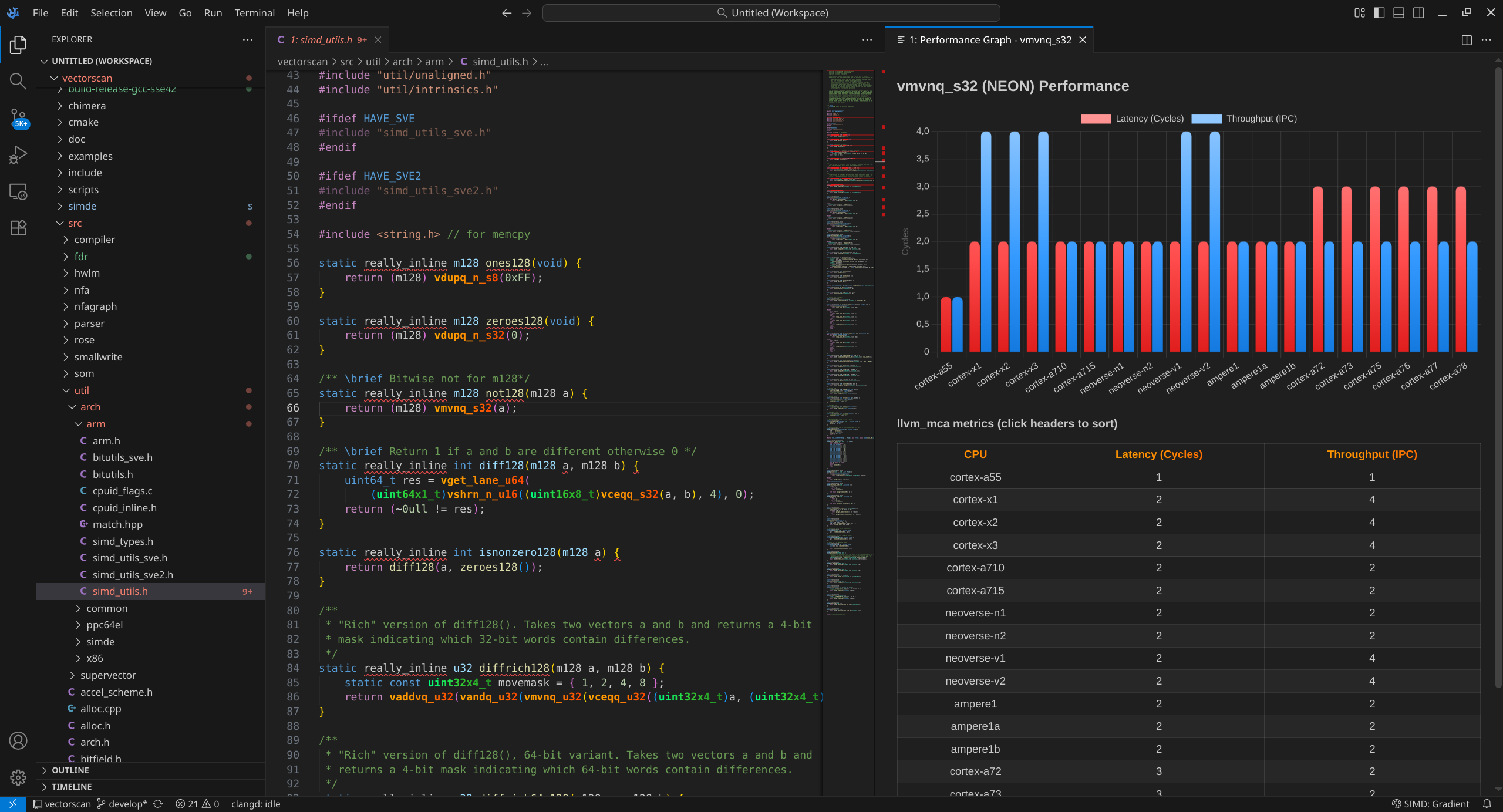
The majority of value, however, comes from Code.SIMD, where all SIMD.info data is integrated directly into your VSCode environment:
- Every intrinsic across architectures
- Assembly instructions involved
- Latency and throughput per CPU model
- All in one organized, searchable interface
Subscription Plans
- Free Plan: Full access to all x86 SSE4.2 intrinsics within Code.SIMD.
- Full Access:
6.70 EUR/month or 67.00 EUR/year for all SIMD engines and full latency/throughput data.
Upcoming Architecture Support
We plan to expand coverage to:
- Arm SVE/SVE2
- RISC-V RVV 1.0
- MIPS MSA
- Loongson LSX/LASX
- Matrix engines: Intel AMX, Arm SME2, POWER10 MMA
Step 3: SIMD.ai Agent Embedded in VSCode
A new deterministic AI agent is in development and will be integrated directly into the VSCode extension.
It will be offered as an optional add-on. More details will be shared soon.
Closing Note
Thank you for your interest, support, and patience throughout the SIMD.ai testing period.
VectorCamp
The SIMD.info / SIMD.ai team
SIMD Intrinsics Summary
| SIMD Engines: | 6 |
| C Intrinsics: | 10444 |
| NEON: | 4353 |
| AVX2: | 405 |
| AVX512: | 4717 |
| SSE4.2: | 598 |
| VSX: | 192 |
| IBM-Z: | 179 |
Recent Updates
November 2025- LLVM-MCA Metrics: Added latency and throughput data for each intrinsic on a per-CPU basis, plus overall plots for visual analysis.
- IBM-Z SIMD Integration: New SIMD architecture support integrated, including 179 intrinsics.
- Search Engine Migration: Switched from Elasticsearch to Meilisearch — 16× less memory usage, 100× faster responses, and improved search quality.
- Updated Statistics: Scanning expanded to more than 59k repositories, now also including IBM-Z statistics.
Previous Updates
- Intrinsics Organization: Ongoing restructuring of uncategorized intrinsics for improved accessibility.
- Enhanced Filtering: New advanced filters added to the intrinsics tree for more precise results.
- Search Validation: Improved empty search handling with better user feedback.
- Changelog Display: Recent changes now visible to users for better transparency.
- New Blog Post: "Best Practices & API Integration" guide added to the blogs section.
- Dark Theme: Added support for dark theme for improved accessibility and user experience.